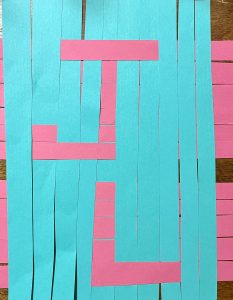
This project began not with scissors or strips of paper, but with a line of code—binary code to be exact. Before weaving anything, I first imagined my initials “JL” in a system of 0s and 1s, assigning pink the value of 1 and blue the value of 0. What at first looked like a simple grid of numbers soon became the blueprint for a physical artwork. The binary sequence guided every decision, serving as the unseen structure behind the final woven image.
Once the code was set, I began the process of cutting paper strips to embody those binary values. Each strip carried meaning: pink was a one, blue was a zero. As I started weaving the strips together, the digital logic of the grid became visible in physical form.
What fascinated me most about this process was the contrast between digital and physical. In the digital realm, binary code is exact, efficient, and infinitely reproducible. A “JL” rendered by a computer would look the same every single time, crisp and perfect. But in the physical weaving, imperfections became part of the charm—the uneven cuts, the slight shifts in alignment, the texture of the paper itself. These details can never be captured in a purely digital version.
Something is gained in both directions. Digital systems offer speed, precision, and the power to replicate endlessly. Physical making, however, carries texture, uniqueness, and the visible presence of human labor. In the end, my woven initials revealed how the two worlds—code and craft—intersect. The project became more than just paper weaving; it was a translation of binary logic into a handmade form, proving that even 0s and 1s can take shape off the screen, in the weave of human hands.
Crafted with the help of ChatGPT